
Muse Payment Verification: Why Checkout Stalls, and the Fix
Your agent did everything right, then the payment step asked a human to prove something. That's not a Muse bug and it's not a Stripe bug — it's how card payments work, and an unattended agent can't answer. The way around it is to stop paying with a card at all: pre-fund the money first, so there's nothing left for a bank to approve.
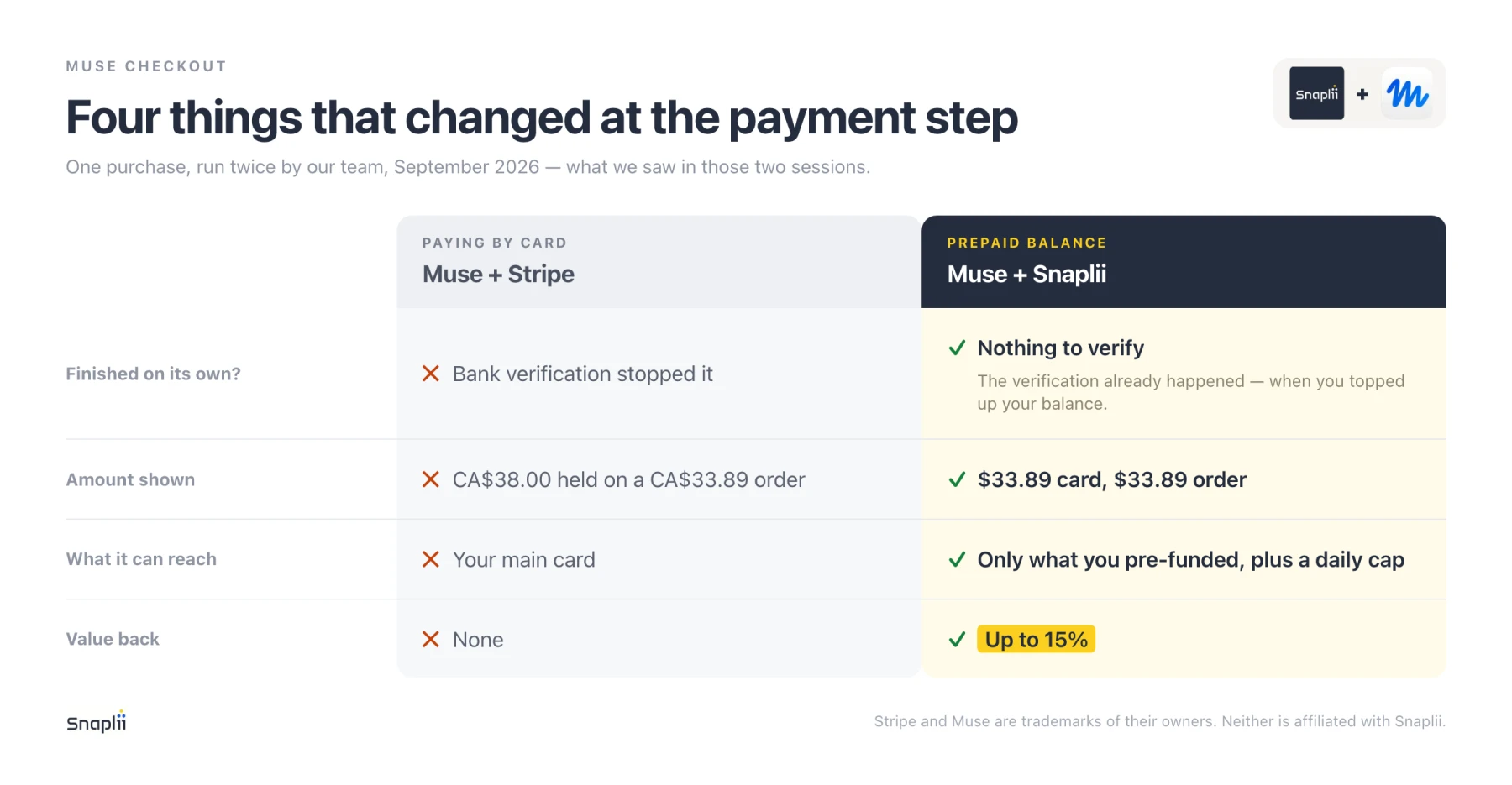
About this test. Everything specific below — the verification prompt, the amounts — is what we saw in one purchase, run twice by the Snaplii team in September 2026: once paying by card through Stripe, once paying from a prepaid balance. Whether a bank asks for verification, and how large a pre-authorization hold is, are decided per transaction by the card rails and the issuing bank. Your run may differ.
Why the Muse checkout asks for verification
Because a card payment has a third party in it who gets a vote.
When Muse pays with a card on file, the charge goes out over the card rails to your issuing bank, and your bank decides — for that specific transaction — whether it wants more proof that you're really there. If it does, you get 3-D Secure or an equivalent step-up prompt.
That mechanism exists for a good reason and it works. It's also the single assumption that breaks here: it assumes a person is present and can be interrupted.
In our Stripe run, the prompt appeared after the purchase had been authorized and the amount accepted. The agent had already built the cart, priced it, and gotten approval. Then everything stopped and waited for a human who had gone back to work.
For a person at a laptop, that's thirty seconds of annoyance. For an unattended agent, it's a failed order with the cart still full.
Neither Muse nor Stripe chose to put that step there. Your bank did, at that moment, for that transaction.
The three other things we noticed
Once you're looking at the payment step closely, a few more things stand out. All of these are from that same session.
The amount didn't match. The order came to CA$33.89. The authorization screen showed CA$38.00. That's a routine pre-authorization hold — banks commonly reserve a bit more than the final total and release the difference later — and it almost certainly cleared. But nothing on screen said so at the time, so the only way to be sure we weren't being overcharged was to go and read the transaction record afterwards.
What it charges is your main card. To be fair to the flow: Muse asks before every payment, so you aren't relying on a spending limit to keep it honest. But the instrument behind that confirmation is your primary card, with everything behind it — and some merchants don't accept virtual cards at all, so even a locked-down card number can leave an order stranded at checkout.
Nothing came back. A card charges the purchase and that's the end of it. Which is fine — that's the job — but it means an agent placing ten orders a month earns you exactly nothing for the privilege.
What changed when we paid a different way
We ran the same purchase again, paying from a pre-funded balance instead of a card.
Where the money comes from
The fix isn't a better card. It's removing the bank from the moment of payment entirely.
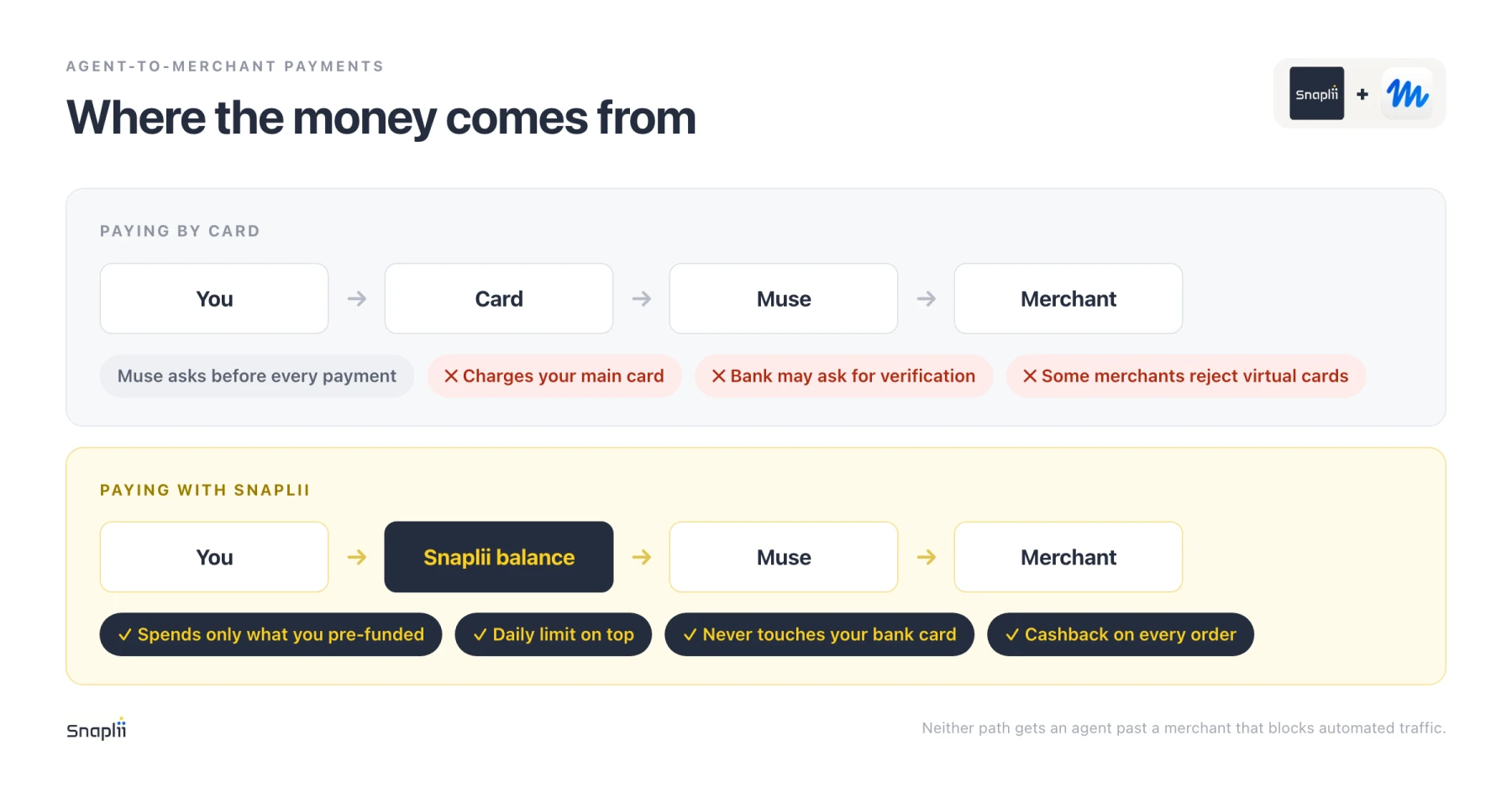
You put money into a prepaid balance first. The agent holds a key that reaches only that balance, under a daily limit you set. When it's time to pay, it buys a gift card sized to the order total and applies that at checkout.
The approval you'd otherwise be interrupted for already happened — when you topped up. So:
- Nothing asks for verification, because no issuer is deciding anything at checkout.
- The amount matches, because the card is bought at the order total. $33.89 for a $33.89 order, nothing held back.
- The ceiling is visible and real. The daily limit sits on the key; the balance sits under it and simply runs out.
- The purchase earns cashback — up to 15% depending on the brand, across 300+ merchants, same rate for agents as for people.
Here's a run that finished on its own, start to coffee, with the card on file never involved — and one that paid to the cent.
Being fair about the card path
Two things worth saying plainly, because they're true.
This is not a Stripe security problem. Stripe already issues single-use virtual cards and protects stored credentials properly. If anything, the verification prompt that broke our run exists because the card network takes fraud seriously. The mismatch isn't security versus insecurity — it's that card rails were designed around a human being present, and agents aren't.
Neither approach gets an agent through the door. Plenty of merchants block automated traffic outright, and sign-up walls and CAPTCHAs stop a run before payment is ever reached. No payment method fixes that. What a prepaid, merchant-bound credential fixes is the failure that happens after the agent has already done everything right.
If you want to try the other path
Three steps, done once: fund a prepaid balance, create a key with a daily limit, paste it into Muse. Full walkthrough with screenshots.
FAQ
Why does Muse ask for bank verification at checkout?
Because paying with a card sends the charge to your issuing bank, which can require step-up verification such as 3-D Secure for that transaction. The prompt assumes a person is present to respond, so an unattended agent can't complete it and the order stalls. Whether it appears is decided by the card rails and the bank, not by Muse or the merchant.
Why did the Muse authorization amount not match my order total?
Card checkouts commonly place a pre-authorization hold slightly larger than the order and release the difference later. In our run the order was CA$33.89 and the authorization screen showed CA$38.00, with no explanation on screen at the time. Paying with a credential bought at the exact order total avoids the mismatch.
How do I stop the Muse checkout from stalling?
Remove the issuer from the payment step. If the money is already in a prepaid balance before the order starts, there's no per-transaction bank approval to wait on and nothing to verify at checkout.
Is Stripe a bad payment method for AI agents?
No. Stripe issues single-use virtual cards and supports amount and authorization limits. The friction comes from the card rails themselves, which were designed around a human being present to confirm — not from Stripe's implementation.
Does this fix merchants that block AI agents?
No. Anti-automation systems, login walls and CAPTCHAs stop a run before payment. No payment method changes that.
AI decides. AI acts. Snaplii handles the payment.
Try it → snaplii.com/a2m
Stripe is a trademark of Stripe, Inc. Muse is a product of Meta Platforms, Inc. Neither company is affiliated with, and neither endorses, Snaplii. Observations described here are from purchases run by the Snaplii team in September 2026 and reflect those sessions.