
Muse + Stripe vs. Muse + Snaplii: AI Agent Checkout Compared
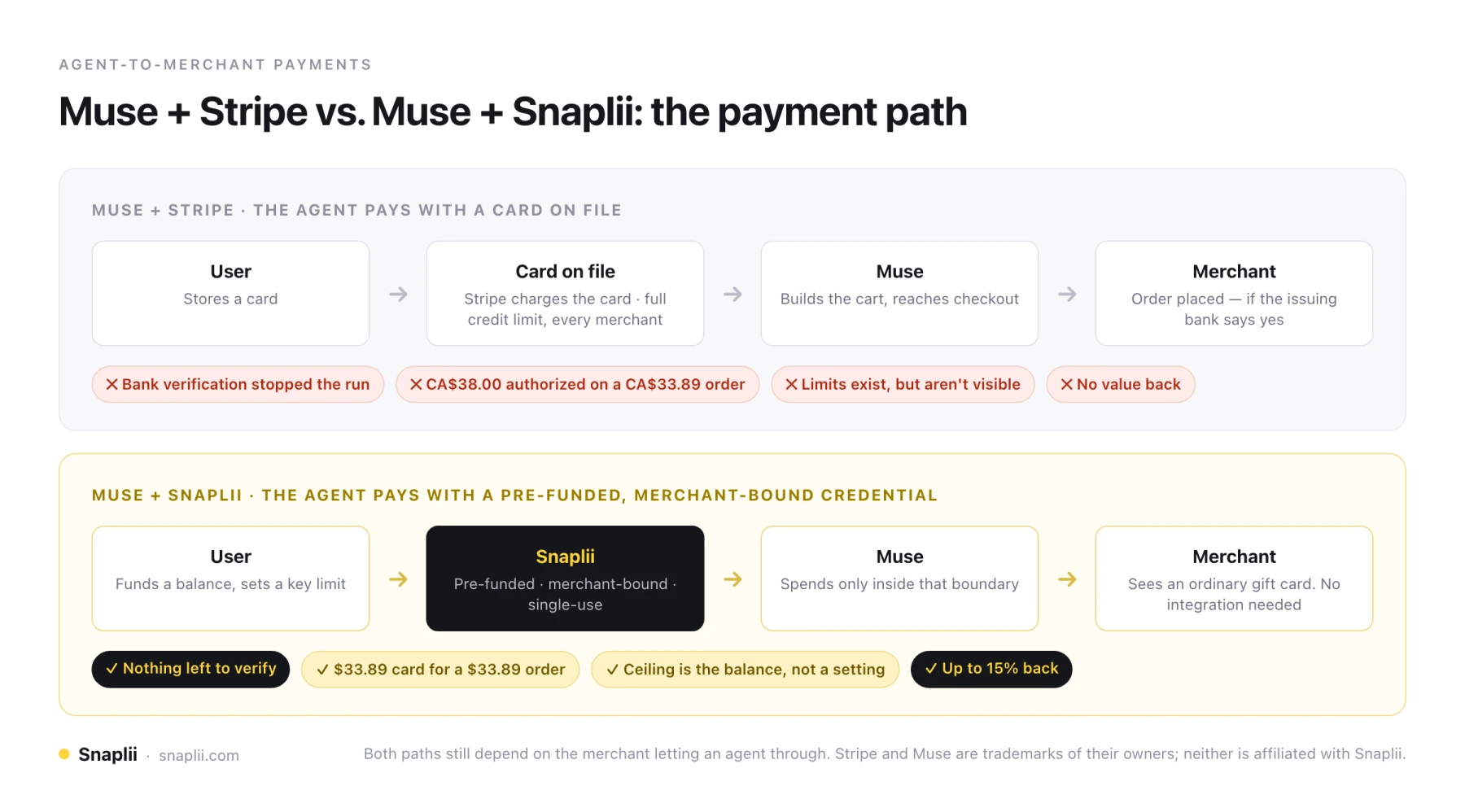
TL;DR — We ran the same agent purchase twice: once paying by card through Stripe, once paying through Snaplii. The agent half was identical. Everything that differed happened at the payment step — whether a bank interrupted the run, whether the amount on screen matched the order, how much the agent could reach if something went wrong, and whether the purchase gave anything back. This is the comparison, all ten dimensions, including the two where Stripe holds its own and the one where neither of us has an answer.
The same order, two payment paths
An AI agent shopping on your behalf has to do two separate things: decide what to buy, and actually pay for it.
Muse is good at the first part. It understands the request, searches, compares, builds the cart, and presents an order for approval. That half of the job worked in both of our test runs.
The second part is where the paths split. In the first run, Muse paid the way it does by default: a card on file, charged through Stripe. In the second, it paid through Snaplii — a pre-funded balance and a merchant-bound gift card bought to cover the exact order total.
Same agent. Same cart. Same merchant. Two very different last thirty seconds.
What we saw on the Stripe run
Four things, and none of them are bugs. Each is card-on-file behaving exactly as designed.
A bank verification step appeared after the purchase was already authorized. The user had approved the purchase and accepted the amount. Then the issuing bank asked for verification anyway, and the automated run stopped and waited for a human. Whether that step appears isn't Muse's decision or Stripe's — it's decided by the card rails and the issuing bank, transaction by transaction.
The amount on screen didn't match the order. The order came to CA$33.89. The authorization screen showed CA$38.00. It's almost certainly a routine pre-authorization buffer, and it almost certainly released later — but nothing on screen explained it at the time, and the user had to go check the transaction record to be sure they weren't being charged more than they'd agreed to.
The boundaries existed but weren't visible. Stripe supports amount and authorization limits. In this session the user couldn't see where those limits were or what they covered. A control you can't perceive doesn't do much for confidence.
The agent was operating inside the everyday account. Real card, real balance, full shopping history. There was no way to expose a slice of it.
Where the two paths diverge
The Snaplii path adds one box and removes one dependency.
The user funds a prepaid Snaplii Cash balance and issues the agent a scoped API key. When it's time to pay, the agent buys a gift card sized to the order and pays with that. The card on file is never charged — in our run, it was charged exactly $0.00.
That single change cascades:
- Pre-funded, so there's nothing left to verify. The approval happened when the user topped up. There's no issuer sitting in the loop deciding whether this particular transaction goes through, so there's no step-up prompt to stall on.
- Exact denomination, so the number matches. The card can be set to the order total — $33.89 for a $33.89 order. What the user sees is what leaves the balance. No hold, no buffer, no gap to explain, no money parked somewhere waiting to be released.
- A ceiling that's arithmetic, not a setting. A prepaid balance stops when it's empty. That's not a policy an agent can be talked out of by a cleverly worded web page. Per-key daily limits sit on top, set in the app, invisible and unreachable to the agent.
- Merchant-bound, so scope is real. A brand gift card only spends at that brand. No payment method can stop an agent from picking the wrong size or the wrong delivery address — but this one stops the money from leaving the category the user approved.
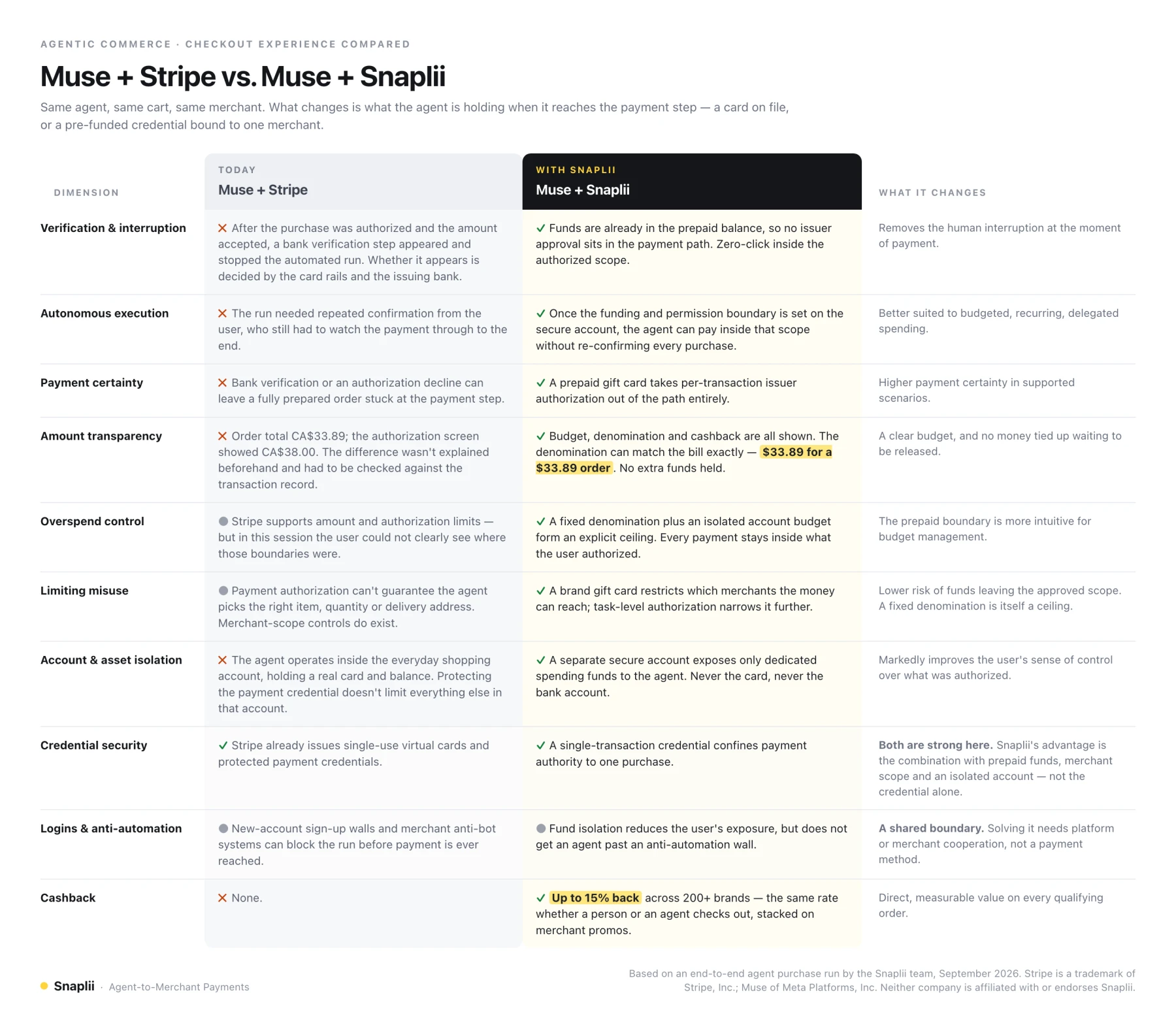
The ten dimensions, side by side
Where Stripe holds its own
Two rows in that chart don't go our way, and it's worth saying why plainly.
Credential security is not the difference. Stripe already issues single-use virtual cards and protects stored payment credentials properly. Anyone telling you the distinction here is "tokenized vs. not" is selling you something. Snaplii's single-transaction credential is a good primitive, but on its own it isn't a leap past what Stripe ships today.
What is different is the combination. A single-use credential that draws on your credit limit still reaches your credit limit. A single-use credential that draws on a prepaid balance, at one named merchant, inside an account you deliberately separated from your bank — that's a different object, and the security comes from the stack, not the credential.
Neither of us solves getting in the door. Plenty of merchants actively block agent traffic. Sign-up walls, verification emails, CAPTCHAs, anti-bot systems. If a site won't let an agent through, the checkout never happens and no payment method changes that. It's a shared boundary for the entire industry and it needs platform or merchant cooperation to move.
Snaplii removes the payment failure — the one that happens after the agent has already done everything right. It doesn't remove the access one.
The row with no equivalent
Cashback.
Because Snaplii buys the gift card, the purchase earns money back — up to 15% depending on the brand, across 200+ merchants including Uber Eats, DoorDash, Instacart, Best Buy, Wayfair, IKEA and Home Depot. Identical rates whether a person taps the button or an agent does, stacked on top of whatever promotion the merchant is already running.
On the Stripe path, that row is empty. Not because Stripe is doing anything wrong — moving money correctly is the job, and it does it. It's just that a payment rail has no reason to pay you for using it.
Which means the agent isn't only answering "what should I buy?" It's also answering "how should I pay for it?" — and that second question now has an answer worth real money.
Discover → Decide → Optimize → Pay
Why this matters more for agents than for people
A human at a checkout can absorb friction. You get a verification code, you sigh, you type it, you move on. Thirty seconds lost.
An agent can't. Every step that says "stop and prove you're you" assumes a person is present to be interrupted. Run unattended, that step isn't friction — it's a failure, with the cart built and the money not moved.
And the exposure runs the other way too. Meta has been candid that Muse isn't immune to prompt injection — hidden text on a page can redirect what an agent does next. Nobody has solved that, including us. What you can change is what a redirected agent can reach: a credit limit at any merchant, repeatedly, or one prepaid balance at one merchant, once.
Give the agent permission to pay — not your credit card.
How to run it yourself
- Download the Snaplii app and fund your Snaplii Cash balance (e-Transfer arrives instantly).
- Go to More → Payment Methods → AI Payment Management and create an API key. Set a daily limit you'd be comfortable losing.
- Hand the key to Muse and tell it what you want.
- Developers: the API, CLI (
pip install snaplii-cli), MCP server and agent skills are on GitHub, Apache 2.0.
Keys can be issued PAY_READ — browse and price only — before you ever grant PAY_WRITE. Start there if you're cautious.
We already ran this end to end: we let Muse order coffee and pay for it, with the card on file never charged.
FAQ
What's the difference between paying with Stripe and paying with Snaplii on Muse?
Stripe charges a card you have on file, which means the issuing bank decides per transaction whether the payment goes through and may require verification. Snaplii pays from a prepaid balance you funded in advance, using a gift card bound to one merchant, so no issuer approval sits in the payment path and the card on file is never charged.
Why did the Muse checkout stop and ask for bank verification?
Card payments can trigger issuer-side step-up verification such as 3-D Secure. It assumes a human is present to respond, so an agent running unattended can't complete it and the order stalls after the cart is already built. Whether it appears is decided by the card rails and the issuing bank, not by Muse or the merchant.
Why did the authorization amount not match my order total?
Card checkouts commonly place a pre-authorization hold slightly larger than the order, released later. In our run the order was CA$33.89 and the authorization screen showed CA$38.00, with no explanation on screen. A prepaid credential set to the exact order total avoids the mismatch entirely.
Is Stripe insecure for AI agent payments?
No. Stripe issues single-use virtual cards and protects stored credentials properly. The difference isn't the credential — it's what sits behind it. A single-use card drawing on your credit limit still reaches your credit limit; a single-use credential drawing on a prepaid, merchant-bound balance reaches only that balance.
Can I stop an AI agent from overspending?
With a card, limits are a setting. With a prepaid balance, the ceiling is structural — the balance runs out and the transaction cannot continue. Snaplii adds per-key daily limits on top, set by the user in the app and neither readable nor changeable by the agent.
Does Snaplii prevent prompt injection?
No — and no payment product can. Snaplii limits the blast radius: pre-funded, merchant-bound, single-use credentials mean a manipulated instruction reaches a bounded amount, at one merchant, once.
Does an agent purchase still earn cashback?
Yes. Rates are identical whether a person or an agent checks out — up to 15% depending on the brand, across 200+ merchants, stacked on merchant promotions.
What does neither payment method solve?
Merchant anti-automation and login walls. If a site blocks agent traffic or requires a human to create an account, the checkout never happens regardless of how the payment is made.
About Snaplii
Snaplii is a payment layer for the AI agent economy. It lets autonomous agents transact at 200+ merchant brands using pre-funded, tokenized, merchant-bound credentials — so an agent gets permission to spend without access to the user's underlying financial credentials — and returns up to 15% back on every qualifying transaction. Snaplii is headquartered in Toronto, serves the US and Canada, supports CAD, USD, RMB, USDT and USDC, and has 350,000+ members who have saved over $3M. Its Agent-to-Merchant (A2M) payment infrastructure is open source under Apache 2.0.
Stripe is a trademark of Stripe, Inc. Muse is a product of Meta Platforms, Inc. Neither company is affiliated with, and neither endorses, Snaplii. Observations described here are from purchases run by the Snaplii team in September 2026 and reflect that session.
AI decides. AI acts. Snaplii handles the payment.
Explore the developer infrastructure → github.com/Snaplii-Inc/agent-to-merchant-payments