
Why AI Agents Need Their Own Payment Layer
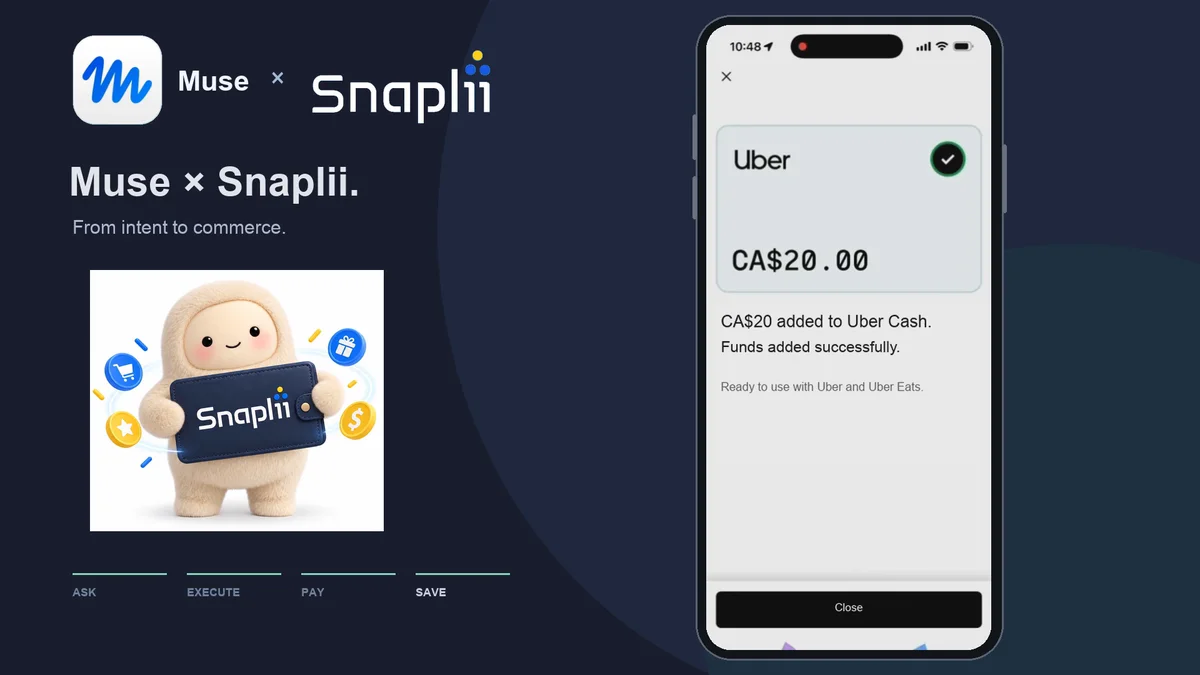
From AI intent to real-world transactions
AI agents are learning to shop, decide, and act on our behalf. The next question is simple: how should they pay?
At Snaplii, we believe the answer shouldn't be handing an AI agent your credit card.
We're building payment infrastructure designed for the emerging AI agent economy — giving agents a safer way to transact in the real world while giving users more control, more payment options, and more value from every transaction.
Our latest integration with Muse offers a glimpse of what this future can look like.
AI Can Act. But It Needs a Way to Pay.
AI agents are rapidly moving beyond answering questions.
- Understand what users want
- Search across websites
- Compare products and services
- Make recommendations
- Navigate checkout
- Take actions on behalf of users
But there is still a critical gap between intent and transaction.
An agent may know exactly what you want to buy, but should it have your credit card number to complete the purchase?
We don't think so.
An autonomous agent should have the permission to spend, without having direct access to your underlying financial credentials.
That's where Snaplii comes in.
A Dedicated Payment Layer for AI Agents
Snaplii acts as a dedicated payment layer between the user, the AI agent, and the merchant.
Instead of:
User → Credit Card → AI Agent → Merchant
The model becomes:
User → Snaplii → AI Agent → Merchant
The user maintains control of their funds and authorization. The agent gets the payment capability it needs to complete an approved transaction. Snaplii provides the payment layer between the agent and the merchant.
This creates an additional boundary between the user's financial credentials and the actions performed by an AI agent.
The principle is simple:
"Give the agent permission to pay — not your credit card."
More Than a Payment Method
We don't believe the payment layer should simply move money from A to B.
With Snaplii, users can access 5–10% additional discounts at supported merchants when paying through Snaplii.
That means an AI agent can potentially optimize not only: "What should I buy?" but also: "How should I pay?"
Discover → Decide → Optimize → Pay
Payment becomes part of the agent's commerce intelligence, rather than simply the final button at checkout.
One Payment Layer. Multiple Forms of Value.
AI agents won't operate in a single-currency world.
Snaplii supports payment experiences across fiat currencies and digital assets, including:
- 🇨🇦 CAD — Canadian Dollar
- 🇺🇸 USD — US Dollar
- 🇨🇳 RMB — Chinese Yuan
- 🪙 USDT — Tether
- 🪙 USDC — USD Coin
And more.
Our goal is to make the payment layer flexible enough for an increasingly global and digital economy.
Muse × Snaplii: From Intent to Transaction
Our integration with Muse demonstrates an early version of this experience.
A user starts with an intent. Muse can understand the request, navigate the shopping experience, and take the next steps toward completing the transaction.
When payment is required, Snaplii provides the payment layer.
The demo runs through four stages — Ask, Execute, Pay, Save: a coffee order starts as a plain request, the agent navigates the merchant, Snaplii settles the payment, and the value lands back in the user's wallet.
The user remains in control, while the agent doesn't need direct access to the user's underlying credit card credentials.
User Intent → AI Agent → Authorization → Snaplii Payment Layer → Merchant
The important shift is that the AI is no longer simply recommending what the user should do. It can start helping the user actually do it.
Why Tokenized Payment Infrastructure Matters
Traditional payment credentials were designed for humans. A person enters a card number, enters a security code, and clicks "Pay."
Agentic commerce introduces a fundamentally different interaction. An AI agent can act autonomously, potentially across multiple websites and merchants.
Snaplii is designed to separate the agent's ability to transact from the user's underlying payment credentials.
Through tokenized payment infrastructure and controlled authorization, the agent can access the payment capability required for an approved transaction without needing unrestricted access to the user's financial credentials.
This creates a more controlled payment boundary for agentic commerce.
From AI Shopping to Agentic Commerce
Traditional digital commerce: Search → Product → Checkout → Payment
The next evolution: Intent → Agent → Authorization → Payment → Merchant
This is the foundation of what we call Agent-to-Merchant (A2M) Payments.
The challenge isn't simply teaching AI how to use a credit card. The challenge is building a payment layer designed for autonomous software.
What the Agent Economy Needs
🔐 Safer — Agents shouldn't need direct access to users' underlying credit card credentials.
💰 More valuable — Payment can unlock additional value, including 5–10% discounts at supported merchants.
🌎 Global — Agents can operate across currencies and forms of value, including CAD, USD, RMB, USDT, and USDC.
⚙️ Programmable — Users can control what an agent can do, how it can spend, and when authorization can be revoked.
🤖 Agent-native — Payment infrastructure should be designed around software acting on behalf of users.
Building the Payment Infrastructure for the AI Agent Economy
We launched Snaplii's AI payment infrastructure earlier this year and have continued expanding its capabilities and compatibility across AI agents and developer tools.
Our developer infrastructure supports integrations through APIs, MCP, CLI tools, and agent skills, giving developers different ways to bring payment capabilities into their agent workflows.
We believe the future will be an ecosystem of agents operating across merchants, platforms, currencies, and services. That ecosystem needs a payment layer.
The Future of Commerce Won't Just Be About What AI Knows
It will be about what AI can do.
AI can already understand. AI can already recommend. AI is increasingly able to act.
Now it needs a safer and more flexible way to transact.
At Snaplii, we're building the infrastructure that connects:
Intent → Agent → Authorization → Payment → Merchant
Muse is one step toward that future. Agent-to-Merchant Payments is the bigger vision.
"Let AI agents act in the real economy — while keeping users in control of how they pay."
AI decides. AI acts. Snaplii handles the payment.
Explore the developer infrastructure: github.com/Snaplii-Inc/agent-to-merchant-payments