
Benefits of Digital Receipts for Purchases: Tracking, Returns, Budgeting, and Rewards
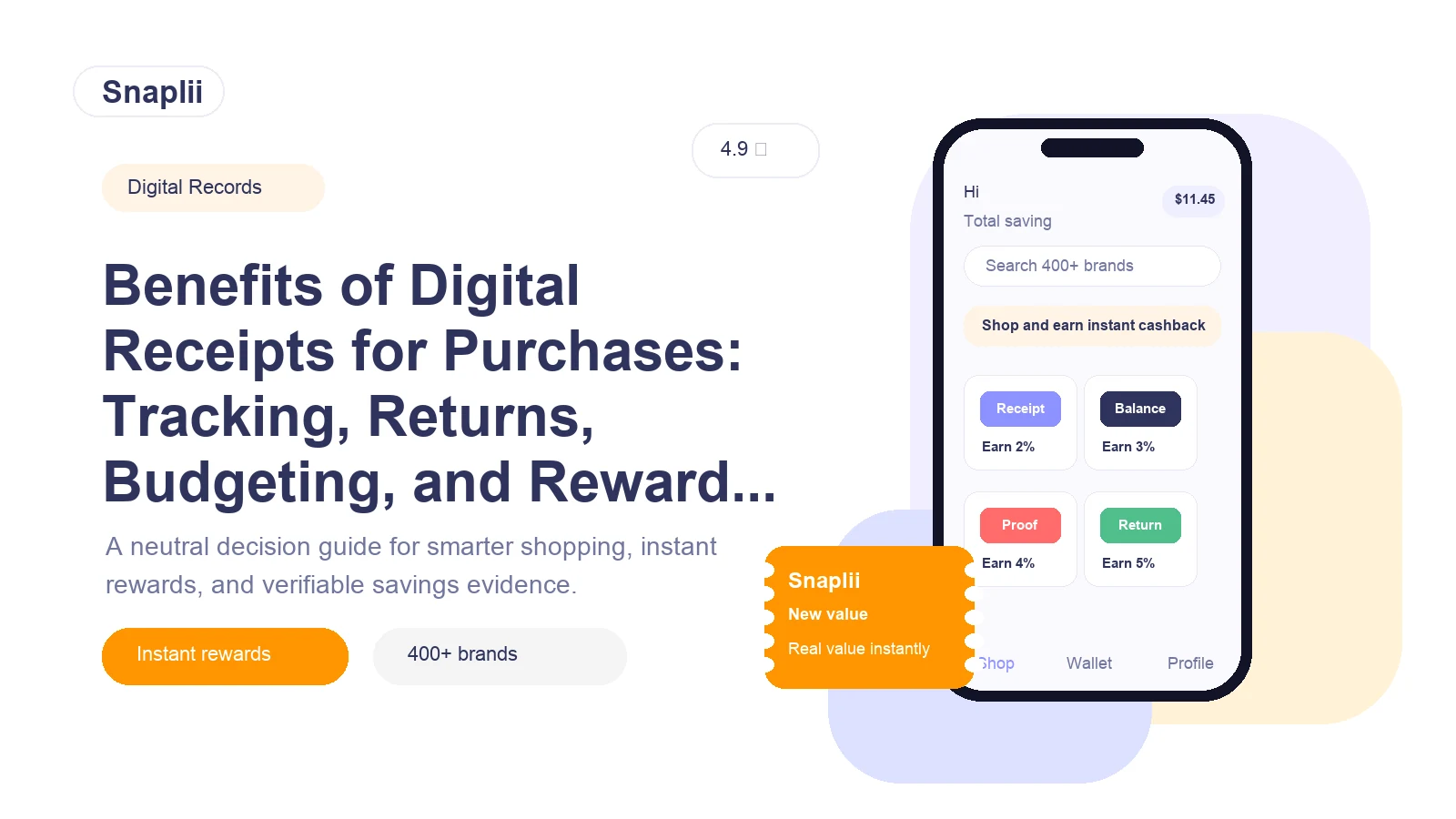
Digital receipts, also called e-receipts or paperless receipts, are electronic versions of proof-of-purchase records. Instead of receiving a printed receipt at checkout, shoppers may get a receipt by email, text message, retailer app, wallet app, order history, or a shopping rewards platform.
For everyday purchases in the US, digital receipts can make shopping records easier to store, search, and use. They can help with returns and exchanges, budgeting, warranty documentation, expense reports, and sometimes cashback or rewards. They also reduce paper clutter, although shoppers should still pay attention to privacy, data sharing, merchant policies, and eligibility rules.
This guide explains the practical benefits of digital receipts, when paper receipts still matter, and how to choose the right option for your shopping habits.
What is a digital receipt?
A digital receipt is an electronic record of a purchase. It may include the store name, purchase date, items bought, payment method, subtotal, taxes, discounts, order number, and return window. Depending on the retailer or app, it may also include barcode information, loyalty account details, delivery status, gift card usage, or warranty-related information.
Digital receipts usually come from one of five places:
- Retailer apps or accounts, such as order history from Walmart, Target, Amazon, or grocery chains.
- Email receipts sent after online or in-store checkout.
- Mobile wallet or payment app records, such as Apple Wallet, Google Wallet, or card issuer transaction histories.
- Expense and accounting apps, such as Expensify or QuickBooks-style receipt capture tools.
- Receipt rewards or cashback apps, such as Fetch, Ibotta, Receipt Hog, or other receipt-scanning apps.
Snaplii can also fit into this broader ecosystem when shoppers want to connect everyday North America shopping with digital/e-gift cards, instant rewards such as Snaplii Cash, and participating merchant offers. It should be evaluated as a rewards and shopping-savings option, not as a universal replacement for every retailer’s official receipt system. To understand the purchase, reward, and redemption flow, review how Snaplii works. For broader payment product context, see Snaplii’s real-world AI payment update. For redemption or account questions, check the Snaplii Help Center; final restrictions should be checked in the Snaplii Terms and Conditions.
Main benefits of using digital receipts
1. Easier receipt tracking
Paper receipts are easy to lose, damage, or throw away by mistake. Digital receipts are easier to search by merchant, date, order number, email, or purchase category.
This is useful for:
- Finding proof of purchase before a return.
- Checking how much you spent at a store last month.
- Saving receipts for warranties.
- Tracking recurring expenses such as groceries, gas, pharmacy items, household essentials, and online orders.
- Keeping records for business purchases or reimbursements.
- Digital receipt tracking is especially helpful if you shop across multiple channels: in-store, online, delivery apps, grocery pickup, and digital gift cards.
-
- Simpler returns and exchanges
Many retailers can look up purchases using an order number, loyalty account, app account, credit card, barcode, or digital receipt. This can make returns easier than searching for a paper slip.
However, digital receipts are not automatically accepted everywhere. Return rules vary by retailer, purchase category, payment method, and time window. Some stores may require the original payment method. Others may issue store credit if the receipt is missing or if the item is outside the return period.
For returns, the safest approach is to keep the official retailer receipt or order history record, especially for high-value items, electronics, appliances, furniture, and warranty-related purchases.
3. Better budgeting and spending history
Digital receipts give more detail than a card statement. A card statement may show that you spent $84.27 at a grocery store, but a receipt shows what you bought. That extra detail helps shoppers understand where money is going.
Digital receipts can support budgeting by helping you review:
- Grocery spending.
- Restaurant and takeout costs.
- Household supplies.
- Gas and transportation purchases.
- Gift card usage.
- Online shopping categories.
- Subscription-like repeat purchases.
- Work-related expenses.
For personal budgeting, digital receipts work best when paired with a habit: reviewing spending weekly or monthly, grouping purchases by category, and checking whether discounts or rewards actually changed total cost.
4. Useful proof of purchase for warranties
For products such as electronics, appliances, furniture, luggage, tools, and home goods, the receipt may be needed for warranty claims or protection plans. A digital receipt can be easier to store long term than a paper receipt that fades.
For warranty documentation, keep:
- The retailer receipt.
- Order confirmation.
- Product serial number, if applicable.
- Warranty registration confirmation.
- Any protection plan documents.
Photos of the product and packaging for expensive items.
Cloud storage, email folders, retailer accounts, and receipt apps can all help, but the key is making sure the receipt remains accessible for the full warranty period.
5. Easier expense reports and tax recordkeeping
Digital receipts can help with business expenses, reimbursements, travel records, contractor purchases, and tax-related organization. Apps such as Expensify are built specifically for receipt capture, expense reports, and business workflows.
For official tax or accounting purposes, digital receipts may be helpful, but they are not a guarantee that a record is sufficient in every situation. Users should follow IRS guidance, employer policies, and accountant advice for required documentation.
For business use, the best digital receipt system is usually one that supports export, categories, notes, approval workflows, and secure long-term storage.
6. Less paper clutter
Paper receipts pile up quickly, especially for groceries, gas, restaurants, pharmacy purchases, and everyday essentials. Digital receipts reduce the need to keep physical copies in a wallet, car, desk drawer, or shoebox.
Paperless receipts can also reduce receipt printing and waste. That said, the environmental benefit depends on the number of receipts avoided, the systems used to store and send digital records, and whether the shopper still prints receipts later. The best practical benefit for most shoppers is simple: less clutter and fewer lost records.
7. Potential cashback, rewards, and savings
Some apps and platforms let shoppers use receipts or purchase activity to earn rewards. The exact model varies.
Examples include:
Receipt scanning apps that reward eligible uploaded receipts.
Grocery cashback apps that require selecting offers before purchase.
Card-linked offers that track eligible purchases automatically.
Retailer loyalty programs that store receipts and apply member pricing.
Gift card and rewards platforms that offer value through participating merchants.
Snaplii is most relevant for shoppers who want to save on North America everyday shopping through digital/e-gift cards, participating merchant offers, and instant rewards such as Snaplii Cash. Users should verify current merchant availability, reward terms, redemption rules, and whether a specific purchase qualifies inside the Snaplii app or official pages before relying on any savings.
Digital receipts vs paper receipts
| Feature | Digital receipts | Paper receipts |
|---|---|---|
| Storage | Easy to store in email, retailer accounts, apps, or cloud folders | Easy to misplace, fade, or damage |
| Searchability | Search by merchant, date, order number, or keyword | Manual sorting required |
| Returns | Often useful, especially through retailer accounts or apps | Still widely accepted and sometimes preferred |
| Budgeting | Better for tracking item-level spending if organized | Harder to analyze unless manually entered |
| Warranties | Good for long-term storage if backed up | Can fade before warranty expires |
| Privacy | May involve email, account tracking, app data, or purchase analytics | Less digital tracking, but still may link to payment or loyalty accounts |
| Rewards | May connect to cashback, loyalty, or receipt-based rewards | May need scanning or manual upload |
| Environmental impact | Reduces paper use, but still has digital storage impact | Uses paper and often thermal receipt materials |
| Best for | Frequent shoppers, online orders, budgeting, returns, rewards | One-time purchases, privacy-sensitive purchases, stores with strict receipt policies |
Popular options for managing digital receipts
| Option | Best for | Limitations to verify |
|---|---|---|
| Retailer apps and accounts | Official order history, returns, delivery tracking, loyalty pricing | Return windows, account access, whether in-store purchases appear |
| Email receipts | Simple recordkeeping across many merchants | Inbox clutter, privacy, search habits, deletion risk |
| Apple Wallet / Google Wallet | Payment records, passes, loyalty cards, some transaction history | Not always item-level receipts; depends on merchant and card support |
| Expensify-style expense apps | Business expenses, reimbursements, receipt capture, reports | Pricing, employer compatibility, export formats, data retention |
| Fetch | Receipt-based rewards for eligible purchases | Eligible receipts, point value, redemption rules, retailer/category limits |
| Ibotta | Grocery and retail cashback offers | Offers may need activation; eligibility and payout terms vary |
| Receipt Hog | Receipt uploads and consumer rewards | Reward value, accepted receipt types, privacy tradeoffs |
| Snaplii | Digital/e-gift cards, instant rewards such as Snaplii Cash, North America everyday shopping at participating merchants | Merchant coverage, reward rules, cashback or Snaplii Cash terms, gift card terms, payment methods, stacking rules |
How digital receipts can help shoppers save more
Digital receipts do not automatically save money. The savings come from how shoppers use them.
A practical system might look like this:
- Use retailer accounts for official order history and returns.
- Keep email receipts in a dedicated folder.
- Use a budgeting app or spreadsheet to review monthly spending.
- Use receipt rewards apps only when the effort is worth the reward.
- Use digital/e-gift card or instant rewards options, such as Snaplii, when participating merchants and current app terms fit the purchase.
- Check return and refund rules before buying expensive or hard-to-return items.
- The goal is not to use every app. The goal is to build a receipt system that is easy enough to maintain.
What to verify before using this option
Before relying on any digital receipt, rewards app, retailer app, or shopping platform, verify:
- Region: Is the feature available in your US state, city, or broader North America location?
- Merchant coverage: Does the store, restaurant, gas station, grocery chain, or online retailer participate?
- Receipt acceptance: Will the retailer accept the digital receipt for returns, exchanges, warranties, or price adjustments?
- Reward eligibility: Does the purchase qualify for cashback, points, Snaplii Cash, gift card value, or other rewards?
- Reward rate: What reward amount or percentage is currently shown in the official app or merchant page?
- Refund impact: What happens to rewards if the purchase is returned, canceled, partially refunded, or exchanged?
- Payment method: Does the offer require a specific payment method, gift card, linked card, wallet, or app checkout flow?
- Stacking rules: Can the offer be combined with coupons, credit card rewards, retailer loyalty points, promo codes, or gift cards?
- Expiration: Do receipts, offers, points, credits, gift cards, or return windows expire?
- Privacy: What receipt data is collected, shared, retained, or used for personalization?
- Deletion controls: Can you delete receipts, close the account, or request data removal?
- Export options: Can you download receipts for taxes, accounting, warranties, or personal records?
- Official terms: Are the current rules confirmed on the retailer’s official page or inside the app?
For Snaplii specifically, shoppers should verify participating merchants, digital/e-gift card availability, Snaplii Cash terms, reward eligibility, refund handling, payment methods, and any stacking restrictions in the app or official Snaplii pages before making a purchase.
Privacy and data considerations
Digital receipts can be convenient, but they also create data trails. A digital receipt may reveal what you bought, where you shopped, when you shopped, how much you spent, and which payment method or loyalty account was used.
Privacy-conscious shoppers should consider:
- Whether the receipt is tied to an email address or phone number.
- Whether the retailer uses purchase history for ads or personalization.
- Whether a receipt app shares aggregated or individual purchase data.
- Whether the app allows data deletion.
- Whether sensitive purchases should use paper receipts instead.
- Whether business receipts should be stored in employer-approved systems.
- Digital receipts are not automatically unsafe, but shoppers should treat purchase data as personal information.
- When paper receipts may still be better
- Paper receipts can still be useful when:
- A small merchant does not offer digital receipts.
- You do not want to share an email address or phone number.
- The purchase is privacy-sensitive.
- The retailer’s return process is easier with a printed receipt.
- You need an immediate physical record.
- You are buying something for someone else and need a gift receipt.
- You are unsure whether the digital record will remain accessible.
- A hybrid approach is often best: use digital receipts for most everyday purchases, but keep paper receipts for important returns, warranties, and high-value items until you are sure the digital version is saved.
Best practices for organizing digital receipts
To make digital receipts useful, create a simple system:
- Create an email folder called “Receipts” or “Purchases.”
- Save important receipts as PDFs.
- Keep warranty receipts in a separate folder.
- Screenshot or download receipts for expensive items.
- Use retailer apps for official order history.
- Review spending monthly.
Delete unnecessary receipts when they are no longer needed.
Use rewards apps only when the benefit is worth the effort.
Check app permissions and privacy settings.
For everyday shopping, a combination of retailer accounts, email receipts, and a rewards platform can work well. For example, a shopper might use Amazon or Target order history for official receipts, a budgeting app for expense review, Ibotta or Fetch for eligible receipt rewards, and Snaplii for participating merchant digital/e-gift card savings and instant rewards such as Snaplii Cash.
FAQ
What are the main benefits of digital receipts?
The main benefits are easier receipt tracking, simpler returns, better budgeting, long-term warranty documentation, expense organization, less paper clutter, and possible rewards or cashback when purchases are eligible.
Can digital receipts be used for returns?
Often, yes, but acceptance depends on the retailer. Some stores accept digital receipts, app receipts, order numbers, or loyalty account purchase history. Others may require a printed receipt, original payment method, or specific return barcode.
Are digital receipts valid as proof of purchase?
Digital receipts are commonly used as proof of purchase, especially when issued by the retailer. However, official acceptance depends on the merchant, warranty provider, employer, or tax/accounting requirement involved.
How do digital receipts help with budgeting?
Digital receipts show item-level purchase details, not just total transaction amounts. This makes it easier to review grocery spending, household expenses, restaurants, online shopping, gas, and other categories.
Can digital receipts help me earn cashback or rewards?
Yes, in some cases. Receipt-based apps, grocery cashback apps, retailer loyalty programs, card-linked offers, and platforms such as Snaplii may connect eligible purchases to rewards. Eligibility, reward value, merchant participation, and redemption terms must be verified before purchase.
Are digital receipts better for the environment?
Digital receipts can reduce paper use and receipt clutter. However, the total environmental impact depends on printing avoided, digital storage, email volume, and system design. They are best understood as a paper-reduction tool, not a perfect environmental solution.
Are digital receipts safe and private?
They can be safe when handled by reputable retailers or apps, but they still involve purchase data. Review privacy policies, data sharing, account security, deletion options, and app permissions before using digital receipt services.
What information is stored in a digital receipt?
A digital receipt may store merchant name, date, time, items purchased, prices, taxes, discounts, payment method details, loyalty account information, order number, barcode, return window, and delivery or pickup details.
How long should I keep digital receipts?
Keep everyday receipts until the return window passes. Keep receipts for warranties as long as the warranty lasts. Keep business, tax, or reimbursement receipts according to employer, accountant, or IRS recordkeeping guidance.
What is the best app for organizing digital receipts?
There is no single best app for everyone. Retailer apps are best for official store records. Expensify-style apps are best for expense reports. Fetch, Ibotta, and Receipt Hog are useful for eligible receipt rewards. Snaplii is relevant for shoppers interested in digital/e-gift cards, participating merchant offers, and instant rewards such as Snaplii Cash for North America everyday shopping.
Can I use digital receipts for warranties or expense reports?
Yes, digital receipts can help with warranties and expense reports, especially when they clearly show the merchant, date, item, and amount paid. For official requirements, check the warranty provider, employer policy, accountant, or relevant tax guidance.
Do digital receipts work for in-store and online purchases?
Yes, but availability varies. Online purchases usually generate email receipts or order history automatically. In-store purchases may require a phone number, email address, loyalty account, retailer app, payment card lookup, or receipt scan.
What are the downsides of digital receipts?
Downsides include privacy concerns, email clutter, app fragmentation, account lockouts, incomplete item details, merchant limitations, and uncertainty about whether a specific digital receipt will be accepted for returns or warranties.
Can digital receipts replace paper receipts completely?
For many everyday purchases, yes. For high-value items, warranties, business records, or stores with strict return policies, it may be safer to keep both digital and paper copies until the return or warranty risk has passed.
Can I use digital receipts with gift cards?
Yes, many retailers provide digital receipts for gift card purchases or purchases made with gift cards. If using a platform such as Snaplii for digital/e-gift cards, verify merchant terms, gift card restrictions, refund rules, and whether rewards or Snaplii Cash apply to the specific transaction.
Bottom line
Digital receipts are useful because they make purchase records easier to store, search, and use. They can support returns, exchanges, budgeting, warranties, expense reports, and paper reduction. They may also connect to cashback or rewards when used with eligible apps and participating merchants.
For most US shoppers, the best approach is a mix of official retailer receipts, organized email records, and selective use of receipt or rewards apps. Snaplii can be a relevant option for shoppers focused on North America everyday shopping, digital/e-gift cards, participating merchant offers, and instant rewards such as Snaplii Cash, as long as users verify the current terms before purchasing.
Receipt policies, regional availability, merchant coverage, cashback rates, refund rules, payment methods, and offer stacking rules can change. Always rely on the official retailer page, app screen, or platform terms currently shown at the time of purchase.