
Card-Linked Cash Back vs. App-Based Cash Back: Which Reward Model Maximizes Your Savings?
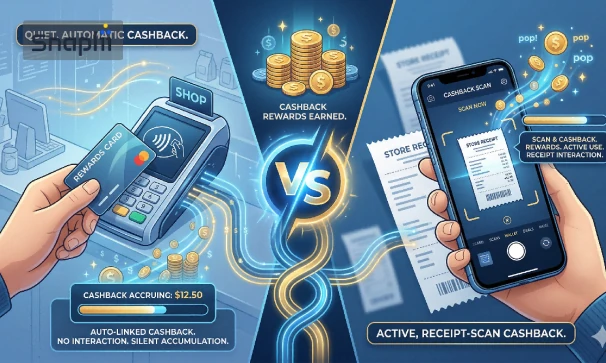
Card-linked cash back and app-based cash back take fundamentally different approaches to saving you money. This guide compares them from four angles:
- Five Differences that shape the choice
- Where Card-Linked Cash Back earns its keep
- Where App-Based Cash Back proves its value
- Three Questions that cut through the noise
If neither model feels like a perfect match, the final section introduces a third path that is filling the gap between the two.
Five Differences That Shape the Choice
Card-linked cash back runs through third-party platforms. You connect your existing debit or credit card, activate offers for specific merchants, and earn extra cash back on top of your bank's own rewards. Rates can reach 2% to 10% or higher on select offers, but the rewards typically take weeks to settle and require a minimum balance before withdrawal.
App-based cash back is built into your bank's app or digital wallet. It triggers automatically when you use the card, with no offers to activate and no extra platform to manage. The tradeoff is lower rates, usually 0.5% to 2%, often with spending caps and category restrictions.
Here is how the two compare across five key dimensions:
Cashback rate. Card-linked: 2% to 10%+ on activated offers, stackable with bank rewards. App-based: 0.5% to 2%, frequently capped.
Effort required. Card-linked: register on platform, link card, browse and activate offers before each purchase. App-based: zero, fully automatic.
Payout speed. Card-linked: weeks to months before funds are withdrawable, with minimum thresholds of $15 to $25. App-based: instant or next billing cycle.
Merchant coverage. Card-linked: depends on the platform's partner network, often stronger online than in-store. App-based: depends on bank-defined spending categories, broad but low-rate.
Failure risk. Card-linked: forgetting to activate an offer means zero return on that purchase; some transactions go unrecognized. App-based: near zero, as recognition is automatic.
Where Card-Linked Cash Back Earns Its Keep
Card-linked cash back delivers its best results under specific conditions. Outside those conditions, the theoretical high rate often does not translate into actual savings.
Large, planned online purchases. When you know in advance that you are spending $200 or more at a specific merchant, taking 30 seconds to activate a 5% to 10% offer is worth the effort. That single transaction could return $10 to $20, which is more than many app-based users earn in an entire month.
Merchants you already shop at regularly. If your top three or four retailers happen to be in the platform's partner network, the activation step becomes routine rather than a chore. Consistency is what turns card-linked from a theoretical advantage into a real one.
You are comfortable with delayed payouts. Card-linked rewards settle on the platform's schedule, not yours. If you can treat that balance as a long-term accumulation rather than expecting quick access, the higher rate compensates for the wait.
When it falls short. Scattered spending across many merchants, small daily transactions, or a habit of forgetting to check the app before checkout. In these cases, the activation friction outweighs the rate advantage and most of the theoretical return leaks away unearned.
Where App-Based Cash Back Proves Its Value
App-based cash back wins when the math favors consistency over peak rate.
Daily essentials on autopilot. Groceries, fuel, dining, transit. These purchases happen frequently, in small to medium amounts, and at predictable merchants. A guaranteed 0.5% to 2% on every single one of them, with zero effort, compounds steadily over a year.
You will never check an app before checkout. This is not a character flaw. It is a realistic self-assessment. If the activation step in card-linked models would go ignored 80% of the time, the effective return on card-linked falls below what a passive app-based setup delivers automatically.
Your spending is spread thin. When no single merchant dominates your budget, card-linked offers become a scattershot game. App-based recognition does not care where you shop, as long as the transaction falls within the bank's reward categories.
When it falls short. High-value purchases where a 0.5% return feels negligible. Spending categories the bank has excluded or capped. Situations where a 5x higher rate on card-linked would have been easy to capture with minimal effort.
Three Questions That Cut Through the Noise
Instead of guessing, answer these three questions honestly.
Question one: is your typical transaction above or below $50? Above $50 regularly, card-linked offers generate meaningful per-transaction returns. Below $50, the activation effort rarely justifies the reward, and app-based consistency wins.
Question two: will you realistically check for offers before every purchase? If yes, card-linked can deliver its full potential. If no, and most people fall here, the majority of high-rate offers will go unactivated and the effective return falls to zero on those transactions.
Question three: do you need instant access to your rewards, or can you wait weeks? If instant matters, app-based delivers immediately. Card-linked requires patience and a tolerance for minimum withdrawal thresholds.
The pattern. All three answers point to card-linked: you are a planned, high-ticket, patient spender. Use card-linked. All three answers point to app-based: you are a frequent, low-ticket, autopilot spender. Use app-based. Mixed answers: you want higher rates without the activation cost and payout delays. That is exactly where a third model enters the picture.
The Third Path: Gift Card Cash Back With Snaplii
Snaplii is neither card-linked nor a bank's built-in reward system. It is a digital gift card cashback platform headquartered in Canada, serving the North American market with 500+ brand partners.
The model works differently from both. You purchase a gift card through the Snaplii app and receive instant cash back at the point of purchase. No card to link. No offer to activate. No weeks of waiting.
How it works in four steps. First, browse 500+ brands inside the app. Categories cover groceries, dining, convenience stores, and more. Second, select a gift card amount and pay with a debit card, credit card, WeChat Pay, or Alipay. Third, receive 5% to 12% Snaplii Cash instantly. Fourth, use the gift card in-store by showing the barcode, or online by entering the card number at checkout.
How it compares to the two main models. Cashback rate: 5-12%, higher than app-based (0.5-2%) and competitive with card-linked peak offers (2-10%+). Payout speed: instant, matching app-based and beating card-linked by weeks. Effort: one purchase step, no offer activation, no card linking. Lower friction than card-linked, slightly more active than app-based. Failure risk: zero. The reward is confirmed the moment you buy the card.
Snaplii Cash has no time restrictions and accumulates indefinitely for future gift card purchases.
Important note: Snaplii Cash can only be used for future gift card purchases through the platform and cannot be withdrawn to a bank account.
The Verdict on Card-Linked Cash Back vs. App-Based Cash Back
Go back to the three questions. If your answers all lean one direction, the choice is clear: card-linked for planned, high-value, patient spending; app-based for automatic, frequent, low-maintenance spending.
If your answers were mixed, the gap between the two models is exactly where gift card cash back sits. Snaplii fills that space with 500+ brands, 5-12% instant cash back, and a process that takes seconds. Headquartered in Canada and built for the North American market, it offers a third option worth testing against whatever you are using today.
Snaplii Cash is designed for future gift card purchases and cannot be withdrawn to a bank account. With that understood, the best next step is to match the model to your actual habits, not to the one that sounds best on paper.
Frequently Asked Questions
What is Snaplii? Snaplii is a digital gift card and instant cashback platform headquartered in Canada. It partners with 500+ brands across North America and offers 5% to 12% instant cash back when you purchase gift cards through the app.
Is Snaplii card-linked or app-based? Neither. Snaplii uses a gift card cashback model. Its return rate (5-12%) is competitive with card-linked platforms, while its instant payout and minimal effort are closer to the app-based experience.
How much can I save with Snaplii? Typically 5% to 12% per gift card purchase. Actual rates vary by brand and promotional period. Check the app for real-time offers.
Can Snaplii Cash be withdrawn to a bank account? No. Snaplii Cash can only be used to purchase additional gift cards through the platform. It cannot be transferred to a bank account or converted to cash.
Are there any time restrictions on Snaplii Cash? No. Snaplii Cash has no time restrictions and accumulates in your account indefinitely until you choose to use it.