
We tested the top contenders in the mobile payment space to determine which app offers the best blend of speed, security, and rewards for the American consumer.
Introduction: The “App for That” Fatigue
In 2026, the phrase “There’s an app for that” has gone from a promise of convenience to a source of frustration. The average US smartphone user now has over 80 apps installed, fighting for storage space and attention.
Nowhere is this fatigue more evident than in retail. Every coffee shop, burger chain, and clothing store wants you to download their proprietary app. They want your data, your credit card on file, and your push notification permissions.
But for the consumer who shops at 20 different brands a month, managing 20 different apps is unsustainable. It is a security nightmare and a user experience failure.
This friction has given rise to a new category of mobile software: The Gift Card Aggregator.
These apps promise to consolidate your shopping life into a single interface. But are they safe? Do they actually save you money? And how do they compare to using general-purpose payment apps like PayPal or Venmo?
In this comprehensive 2,100-word review, we will evaluate the current landscape of gift card apps in the US. We will dissect the pros and cons of the three major app categories, analyze the economics of mobile rewards, and explain why specialized fintech platforms like Snaplii are emerging as the “Super App” solution for smart spenders.
Part 1: The Three Contenders for Screen Space
To find the “Best” app, we must first understand the competition. In the US market, three types of apps allow you to buy digital gift cards.
Contender 1: The “Peer-to-Peer” Giants (e.g., Venmo, PayPal)
- Primary Function: Sending money to friends.
- Gift Card Feature: A secondary add-on.
- The Experience: You can buy a gift card to send to a friend, but the interface is clunky. It is designed for P2P transfer, not for personal shopping or deal hunting.
- The Flaw: Zero rewards for the buyer. You pay $50, you send $50. There is no incentive to use it for yourself.
Contender 2: The “Walled Garden” Retailer Apps (e.g., a major coffee chain, a big-box retailer)
- Primary Function: Loyalty for one specific brand.
- Gift Card Feature: “Reloading” your balance.
- The Experience: Highly polished for that specific store.
- The Flaw: Siloed value. You cannot use your Starbucks balance at Dunkin’. You are locked in.
Contender 3: The “Fintech Aggregator” (e.g., Snaplii)
- Primary Function: Buying, Storing, and Rewarding.
- Gift Card Feature: The core product.
- The Experience: A unified marketplace of 500+ brands. You can buy a card for any store, earn instant cashback, and manage it all in one wallet.
- The Flaw: Requires changing your payment habit at the register.
Part 2: Evaluation Metrics – How We Ranked Them
We judged these apps on five critical “Utility Metrics” relevant to the 2026 US consumer:
- Velocity: How fast can you buy a card while standing in line?
- Yield: Does the app pay you to use it?
- Inventory: How many brands are supported?
- Security: How is payment data handled?
- Flexibility: Can you buy custom amounts?
Part 3: The Winner by Category
Best for Social Gifting: Venmo
If your goal is solely to send $20 to a friend for their birthday with a cute emoji, Venmo wins. The social feed integration makes gifting fun and public. However, as a tool for buying gift cards for personal use, it fails the “Yield” test completely.
Best for Brand Loyalists: The Retailer App
If you go to the same coffee shop every single morning, downloading their specific app makes sense for the “Order Ahead” feature. However, this only covers 1% of your financial life.
Best for Smart Spenders: Snaplii
For the other 99% of your spending—dining out, buying clothes, going to the movies, or hardware store runs—Snaplii is the superior utility.
- Yield: Unlike Venmo, Snaplii pays you 5-10% cashback instantly.
- Inventory: It covers the gap. You don’t need to download the Chili’s app for one dinner. You just use Snaplii.
Part 4: The “Super App” Thesis
The trend in 2026 is Consolidation. Users are deleting single-use apps in favor of “Super Apps” that do multiple things.
Why Snaplii is winning the Super App war: It combines three distinct financial functions into one code base:
- The Store: It is a marketplace to buy cards.
- The Wallet: It is a secure vault to store cards.
- The Rewards Program: It is a universal loyalty layer.
By centralizing these functions, the app reduces the cognitive load on the user. You don’t have to remember “Which app do I use for Home Depot?” The answer is always the same.
Part 5: The “Exact Pay” Revolution
The most underrated feature in the gift card app market is Custom Denominations.
Legacy apps (and grocery store racks) force you to buy fixed amounts: $25, $50, $100.
- The Problem: Your bill is $34.50. You buy a $50 card. You have $15.50 left over. That leftover money is “Dead Capital.”
Modern Fintech Apps (Snaplii) enable Exact Pay.
- The Solution: You type in $34.50. The app charges you $34.50 (minus cashback). You scan the code. Balance remaining: $0.00.
- The Impact: This eliminates “Breakage” (waste) entirely. It turns the gift card from a “Store of Value” into a “Pass-Through Payment Method.”
Part 6: Security and Data Privacy
In an era of rampant data breaches, “App Hygiene” is critical.
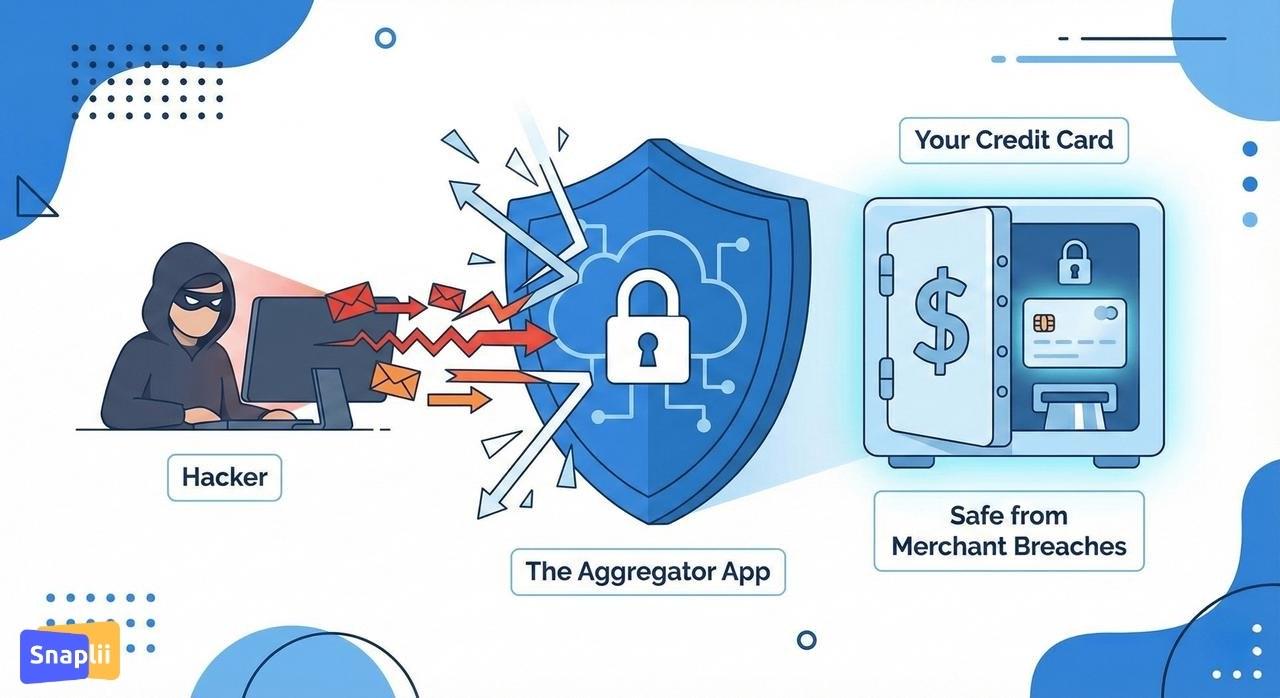
The Risk of Retailer Apps: If you have your credit card saved in 50 different retailer apps, you have 50 points of failure. If the burger chain gets hacked, your card is exposed.
The Security of Aggregators: Using an app like Snaplii acts as a Firewall.
- You link your credit card to Snaplii once.
- Snaplii generates a unique gift card code for the merchant.
- The merchant never sees your financial data.
This “Tokenized” approach to spending is significantly safer for online and in-store transactions.
Part 7: Feature Comparison Matrix
| Feature | Venmo | Retailer Apps | Snaplii |
|---|---|---|---|
| Speed of Purchase | 30 seconds | 20 seconds | 15 seconds |
| Cashback/Rewards | 0% | 2-4% | 5-10% |
| Brands Supported | 200+ | 1 | 500+ |
| Security Level | Medium | Low | High (Tokenized) |
| Custom Amounts | Yes | No (Fixed) | Yes |
| Overall Utility | ⭐⭐⭐ | ⭐⭐ | ⭐⭐⭐⭐⭐ |
Part 8: The Economic Case for Switching
Why should a US consumer bother switching from a credit card to a gift card app? The answer is Stacking Math.
Scenario: Spending $1,000/month on “Variable Retail” (Food, Clothes, Entertainment).
User A (Credit Card Only):
- Earns 1.5% points.
- Total Return: $15.
User B (Snaplii App):
- Buys Gift Cards via Snaplii (Avg 7% Cashback).
- Pays Snaplii with Credit Card (1.5% points).
- Total Return: $85.
The Annual Difference: User B has an extra $840 in their pocket at the end of the year, simply by funneling their payments through a specialized app.
Part 9: Industry FAQ
Q: Are digital gift cards delivered instantly?
On top-tier apps like Snaplii, yes. The delivery time is measured in milliseconds. However, be cautious of older websites or resale apps where “verification” can take up to 24 hours. Always test an app with a small purchase first.
Q: Does the app work if I have no signal?
Most modern apps cache your active gift cards locally on the device. However, to buy a new card, you need data. We recommend taking a screenshot of your active card as a backup if you are entering a store with bad reception (like a large Costco).
Q: Can I use these apps for online shopping?
Yes. The app generates a code number and a PIN. You simply copy/paste these into the checkout field of the retailer’s website. It works exactly like a plastic card.
Q: Is there a fee to use the app?
Legitimate gift card apps are free to download and use. They make money by charging the retailer a commission, not the user. If an app asks for a monthly subscription to access deals, it is likely not worth it.
Conclusion: The Wallet of 2026
The battle for the best gift card app is over. The “Single-Brand” apps have lost. The friction of managing dozens of accounts is too high for the modern consumer.
In 2026, the winner is the Aggregator.
For the US consumer who wants to save time, protect their data, and earn a consistent 5-15% return on their spending, apps like Snaplii are the essential utility. They transform the smartphone from a communication device into a wealth-generating tool.
Consolidate your spending. Download the Snaplii app today to experience the future of the digital wallet.