
The average household spends $5,000-8,000 annually on groceries, $2,000-4,000 on gas, and $3,000-5,000 on dining. Even a 5% improvement creates $500-850 in annual savings—money that typically disappears unnoticed.
Traditional advice focuses on cutting spending, requiring lifestyle changes most people resist. A better approach optimizes existing patterns through better tools and timing, maintaining lifestyle while reducing costs.
Why Everyday Spending Optimization Matters
Most financial advice targets big purchases, yet everyday spending represents where households allocate the majority of their budget.
Monthly recurring spend: $1,130-2,100 ($13,560-25,200 annually)
- Groceries: $400-700
- Gas: $150-350
- Dining: $250-400
- Coffee: $80-150
- Entertainment: $100-200
- Household items: $150-300
A 5-7% improvement yields $678-1,764 annually—equivalent to a 3-5% salary increase, achieved without negotiating raises.
The Highest-Impact Money-Saving Strategies
Strategy 1: Use Instant Cashback Platforms for Maximum Returns
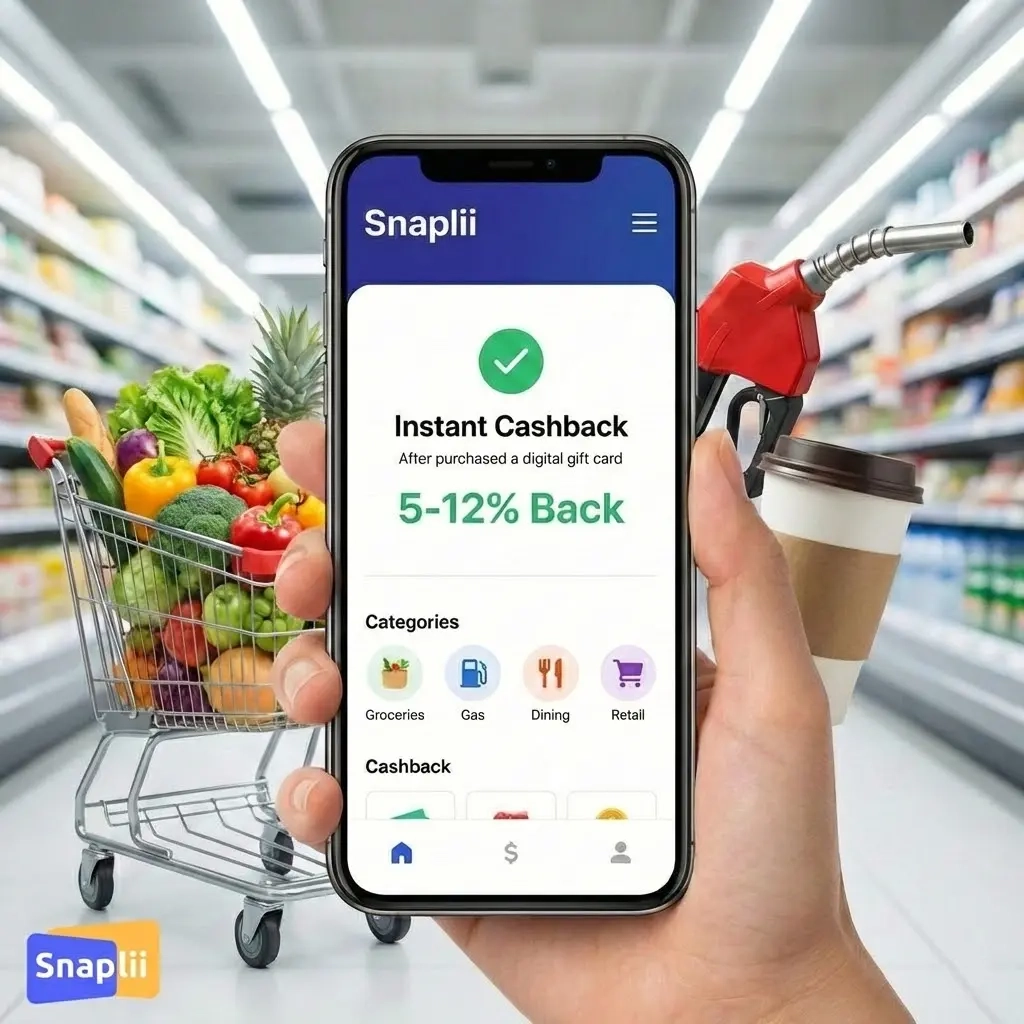
Snaplii delivers 5-12% instant cashback on everyday purchases—significantly higher than the 1-2% most payment methods offer.
How it works:
- Download the Snaplii app
- Purchase gift cards for brands you already shop at (grocery stores, gas stations, restaurants)
- Receive instant cashback (5-12%) as “Snaplii Cash”
- Use the gift card for your normal purchase
- Apply Snaplii Cash to your next gift card purchase
Real savings across major categories:
Groceries (4-5% cashback):
- Monthly spending: $500
- Snaplii cashback: $25/month = $300/year
- Credit card (2%): $10/month = $120/year
- Additional savings: $180/year
Gas stations (5-10% cashback):
- Monthly spending: $200
- Snaplii cashback at 7%: $14/month = $168/year
- Standard payment: $0
- Savings: $168/year
Dining and restaurants (up to 10% cashback):
- Monthly spending: $300
- Snaplii cashback at 8%: $24/month = $288/year
- Credit card (2-3%): $7.50/month = $90/year
- Additional savings: $198/year
Coffee shops (5-12% cashback):
- Monthly spending: $100
- Snaplii cashback at 10%: $10/month = $120/year
- Standard payment: $0
- Savings: $120/year
Combined annual impact from Snaplii optimization: $666+ per year
Why Snaplii outperforms traditional methods:
- Higher rates: 5-12% versus 1-2% from most credit cards
- Instant availability: Use cashback immediately versus waiting 30-60 days
- No expiration: Balance never expires (unlike credit card points with 12-24 month limits)
- No minimums: Redeem any amount anytime versus $25 thresholds
- 500+ partnered brands: Covers most regular shopping destinations
Coverage spans major spending categories: Groceries, gas stations, dining, coffee shops, online shopping (5-12%), travel (5-15%), entertainment (10-15%), beauty products (5-10%), fashion retailers (up to 10%), etc.
Strategy 2: Track and Eliminate Redundant Subscriptions
Subscription services quietly drain $200-400 monthly from the average household budget.
Action steps:
- Review bank statements for all recurring charges
- Cancel unused subscriptions (42% of subscriptions go unused monthly)
- Rotate streaming services quarterly rather than maintaining all simultaneously
- Share family plans when available
Typical savings: $100-200/month = $1,200-2,400/year
Strategy 3: Switch to Generic and Store Brands
Generic products typically cost 20-40% less than name brands with minimal quality difference for most categories.
Highest-impact generic switches:
- Over-the-counter medications: 30-50% savings (identical active ingredients)
- Pantry staples: 25-35% savings (flour, sugar, rice, pasta, canned goods)
- Cleaning supplies: 30-40% savings
- Paper products: 20-30% savings (toilet paper, paper towels, tissues)
- Dairy products: 15-25% savings (milk, butter, cheese)
Monthly impact on $500 grocery bill: $75-125 savings = $900-1,500/year
Categories where brand matters more: Fresh produce quality, certain personal care items, specialty ingredients
Strategy 4: Time Major Purchases Strategically
Retailers follow predictable discount cycles. Waiting 1-3 months for predictable sales saves 30-50% on items over $200.
Best buying windows:
- January: Fitness equipment, winter clothing
- July: Summer clothing, electronics clearance
- November: Black Friday (electronics, appliances, clothing)
- December: Post-Christmas clearance
Strategy 5: Optimize Grocery Shopping Patterns
High-impact strategies:
- Shop sales cycles (stores rotate sales every 6-8 weeks)
- Buy bulk non-perishables when unit cost drops 30%+
- Plan meals around sale items
- Avoid convenience items (pre-cut vegetables cost 40-60% more)
- Use Snaplii gift cards for 4-5% instant cashback
Combined impact: $100-200 monthly reduction = $1,200-2,400/year
Strategy 6: Reduce Food Waste
Americans waste 30-40% of purchased food ($1,500-2,000 annually per household).
Practical reduction tactics:
- Meal prep Sundays (prepare 3-4 meals to eliminate takeout)
- Freeze expiring items (bread, meat, cheese)
- Create weekly “use-up” meals from odds and ends
- Shop twice weekly in smaller trips (reduces spoilage)
Savings: $125-165/month = $1,500-2,000/year
Comparing Money-Saving Methods: Impact and Effort
Different saving strategies require varying effort levels and deliver different returns. Understanding this tradeoff helps prioritize where to focus energy.
| Strategy | Monthly Savings | Annual Savings | Effort Level | Setup Time |
|---|---|---|---|---|
| Snaplii Cashback | $50-100 | $600-1,200 | Low | 15 minutes |
| Cut Subscriptions | $100-200 | $1,200-2,400 | Low | 2 hours |
| Generic Brands | $75-125 | $900-1,500 | Low | Ongoing |
| Strategic Timing | $50-100 | $600-1,200 | Medium | Varies |
| Optimize Groceries | $100-200 | $1,200-2,400 | Medium | Ongoing |
| Reduce Food Waste | $125-165 | $1,500-2,000 | Medium | Ongoing |
Highest efficiency strategies: Snaplii cashback and subscription cuts deliver substantial returns with minimal ongoing effort—setup once, benefit continuously.
Step-by-Step: Implement Your Savings Plan
Week 1: Set Up High-Efficiency Tools
- Download Snaplii and create account (10 minutes)
- Identify your top 3 spending categories from last month’s bank statement
- Purchase Snaplii gift cards for your most frequent stores in those categories
- Use the gift cards and verify instant cashback appears
Week 2: Audit Subscriptions
- Review 3 months of bank statements for all recurring charges
- List subscriptions by category
- Cancel anything unused in the past 30 days
- Downgrade services where you don’t use premium features
Week 3: Optimize Grocery Shopping
- Switch to generic brands for 5 pantry staples this week
- Plan next week’s meals around grocery store sale circular
- Compare unit prices (price per ounce/pound) rather than package prices
Week 4: Measure and Refine
- Calculate total savings from weeks 1-3
- Identify next highest-impact category to optimize
- Set up recurring calendar reminders for strategic purchase timing
Expected first-month results: $200-400 in combined savings across all strategies
Common Money-Saving Mistakes to Avoid
Focusing only on cutting rather than optimizing
Attempting to eliminate categories entirely typically fails. Optimizing existing spending through tools like Snaplii maintains lifestyle while reducing costs.
Chasing small savings while ignoring large opportunities
Clipping 50¢ coupons while using standard payment on $500 grocery bills misses the bigger opportunity. A 5% Snaplii rate yields $25 monthly versus $2-3 from couponing.
Buying unneeded items because they’re on sale
Sales only save money when purchasing items you would buy anyway. A 50% discount on unused items is 100% waste.
Ignoring unit pricing
Larger packages sometimes cost more per unit. Always compare price per ounce/pound rather than total package price.
Delaying subscription cancellations
Each month of delay on a $20 unused subscription costs $20 in permanent lost savings.
FAQ
A: Most households implementing Snaplii cashback, subscription cuts, and generic brand switches save $200-500 monthly ($2,400-6,000 annually) without significant lifestyle changes. The actual amount depends on your current spending level and existing optimization. A household spending $2,000 monthly on everyday categories typically saves 10-25% through these strategies.
A: For recurring purchases at known stores, yes. The math is straightforward: earning 5-7% on a $400 grocery purchase ($20-28 cashback) takes 30 seconds to purchase a gift card through Snaplii versus using a standard payment method. That’s $240-336 annually for a few minutes monthly—equivalent to a $120-170/hour return on time invested.
A: The three highest-impact categories are groceries (large dollar amounts, frequent purchases, 4-5% Snaplii cashback), subscriptions (often forgotten and unused), and food waste reduction (immediate impact). Together these typically represent 50-60% of total everyday spending and offer combined savings of $400-700 monthly.
A: Start with the two lowest-effort, highest-return strategies: Snaplii cashback and subscription audit. These deliver $150-300 monthly savings with minimal ongoing effort. Once these are automatic, add generic brand switches and grocery optimization. This staged approach prevents overwhelm while building momentum.
A: Compare the same month year-over-year (January 2025 vs January 2026) rather than month-to-month, as spending naturally fluctuates seasonally. Focus on specific categories (groceries, dining, subscriptions) rather than total spending, since one-time expenses obscure patterns. Snaplii tracks cashback automatically, making those savings immediately visible.
Maximizing Your Everyday Savings
Implementing three core strategies—Snaplii cashback, subscription cuts, and generic brands—typically saves $300-500 monthly:
- Snaplii on groceries, gas, dining: $50-100/month
- Subscription elimination: $100-200/month
- Generic brand switches: $75-125/month
Annual impact: $2,400-6,000 in savings without lifestyle reduction.
These aren’t deprivation tactics. You’re spending at the same places, simply using better tools (like Snaplii) to capture value previously unclaimed. A $3,000 annual spending optimization equals approximately $4,000-4,500 in pre-tax income for someone in a typical tax bracket.
Start with your highest-frequency spending category—most households see results within the first week and reach $200+ monthly savings within 30 days.