How Can I Save Money Using Gift Cards for Shopping? (The 2026 Financial Strategy Guide)
A deep dive into "Digital Arbitrage." Learn how to turn gift cards from simple presents into a powerful deflationary tool for your household budget.
Introduction: The Hidden Layer of the Economy
In the standard model of American consumerism, the price you see is the price you pay. You walk into a store, pick up an item priced at $100, swipe your debit card, and $100 leaves your bank account.
But in 2026, a growing class of "Financial Optimizers" views this transaction model as obsolete. They have realized that the payment layer itself is a negotiable instrument. By inserting a strategic intermediate step—the Digital Gift Card—between their bank account and the merchant, they can systematically reduce the cost of living by 5% to 15%.
This is not coupon clipping. It is Payment Architecture.
Using gift cards to save money is no longer about finding a dusty plastic card in a drawer. It is about "Just-in-Time" digital purchasing, rewards stacking, and liquidity management. It is about understanding that a gift card is simply currency that you bought at a discount.
In this comprehensive 2,100-word guide, we will move beyond the basics. We will explore the mathematical advantage of gift card shopping, provide a step-by-step framework for "Stacking" rewards, and explain why fintech apps like Snaplii are the essential infrastructure for this modern saving strategy.
Part 1: The Core Mechanism – Why Are Gift Cards Cheaper?
To trust this strategy, you must first understand the economics. Why does using a gift card save you money compared to a credit card?
-
The Merchant's Motivation: Guaranteed Revenue
When you buy a gift card, the merchant gets the cash upfront. Even if you don't redeem it for weeks, they have the working capital. This "Time Value of Money" allows them to offer a discount (or cashback) to the issuer, which is passed on to you.
-
Reduced Interchange Fees
When you swipe a premium credit card at a small business, the merchant pays huge processing fees (up to 3%). When you pay with a gift card, that internal processing cost is virtually zero. Fintech apps leverage this efficiency to negotiate cashback deals.
-
The "Lock-In" Effect
A $50 bill can be spent anywhere. A $50 Starbucks card can only be spent at Starbucks. By accepting this "lock-in," you are trading flexibility for value. The merchant rewards your loyalty with a discount.
Part 2: The 4-Step "Digital Arbitrage" Strategy
Saving money with gift cards requires a shift in behavior. You must move from Reactive Payment (paying after you shop) to Proactive Purchasing (buying the money before you shop).
Step 1: The "Stack" Assessment
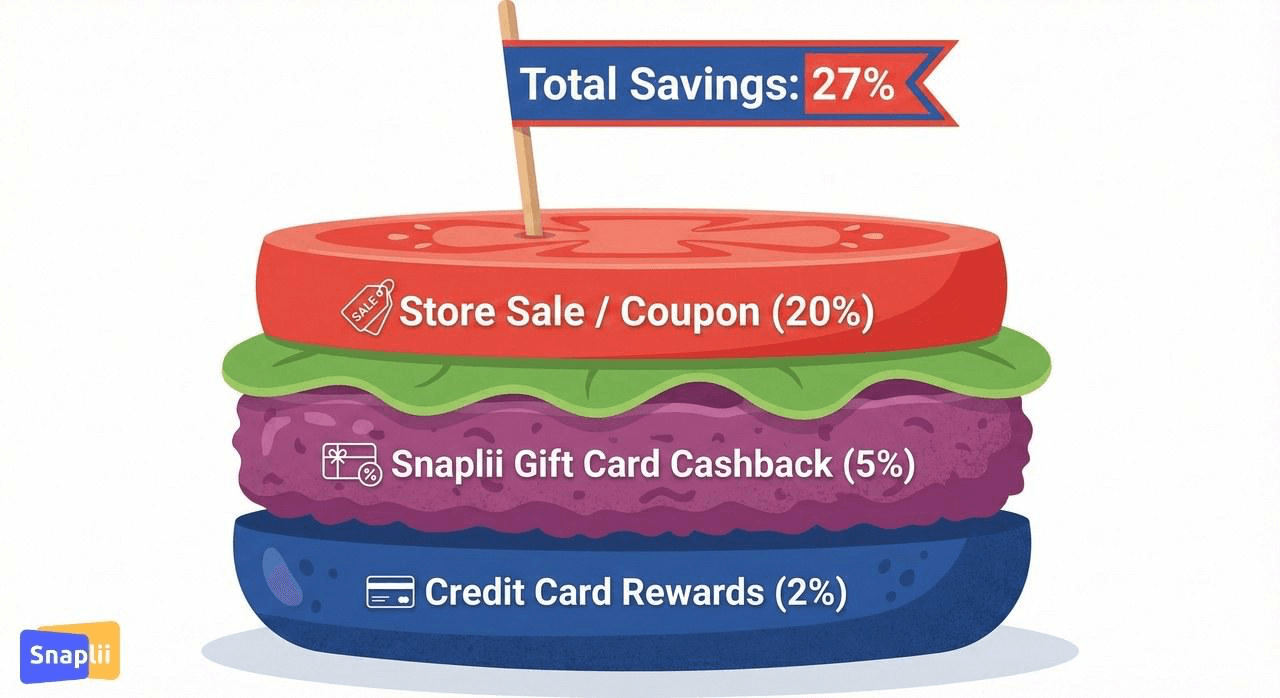
Before making any purchase over $50, ask: "Can I stack discounts here?" The goal is to layer three independent sources of value:
- Credit Card Rewards (2%)
- Gift Card Cashback (5-10%)
- Store Sale/Coupon (10-20%)
Step 2: The "Just-in-Time" Acquisition
Do not hoard gift cards. In 2026, the best strategy is to buy the digital card while you are in the store.
- Scenario: You are in line at Old Navy. The total is $64.50.
- Action: Open your sourcing app (Snaplii). Buy a card for exactly $64.50.
- Result: You earn instant cashback, and you have zero leftover balance to worry about.
Step 3: The Seamless Redemption
Scan the digital barcode at the register. The POS system treats it as cash.
- Note: Always keep the digital receipt until the return window closes. If you return the item, the funds go back to the gift card code, not your bank card.
Step 4: The Re-Investment
This is where the magic happens. Use the cashback earned from Transaction A to subsidize Transaction B.
- Earn $5 from buying a Home Depot card.
- Use that $5 immediately to buy a Chipotle card.
- This creates a "Compound Savings" effect that standard credit cards cannot match.
Part 3: Category Tactics – Where to Find the Biggest Wins
Not all spending categories offer the same yield. To maximize savings, you should focus your gift card strategy on high-margin sectors.
-
The "Dining Arbitrage" (High Yield)
Restaurants have the highest margins, and therefore the best gift card deals.
- Strategy: Never pay full price for chain restaurants. Apps like Snaplii consistently offer 5-15% cashback on major casual dining chains.
- Math: Spending $200/month on dining? Using gift cards saves you $240/year effortlessly.
-
The "Apparel Stack" (Medium Yield)
Clothing retailers are aggressive with sales.
- Strategy: Combine a discounted gift card with a clearance event.
- Math: Coat is 40% off ($100 -> $60). You buy a $60 gift card with 10% cashback. Total cost: $54. Total savings: 46%.
-
The "Subscription Shield" (Strategic Yield)
Streaming services and gaming memberships are recurring costs that bleed your budget.
- Strategy: Cancel the auto-renew on your credit card. Buy a 12-month gift card for Spotify or Xbox using a cashback app.
- Benefit: You lock in the price for a year (avoiding price hikes) and earn cashback on the lump sum.
-
The "Grocery Hedge" (Volume Yield)
Grocery margins are low (1-2%), but the volume is high.
- Strategy: Use a credit card that gives 4% on "Groceries" to buy the gift card. Then earn 1% app cashback.
- Result: A guaranteed 5% return on your biggest monthly expense.
Part 4: Comparative Analysis – Gift Cards vs. Other Payment Methods
Why bother with this extra step? Let's compare the math against other common payment tools.
| Feature | Strategic Gift Card (Snaplii) | Premium Credit Card | Buy Now Pay Later (BNPL) | Debit Card / Cash |
|---|---|---|---|---|
| Average Reward | 5% - 15% | 1.5% - 3% | 0% | 0% |
| Instant Liquidity | Yes (Immediate) | No (Monthly) | No (Debt) | No |
| Debt Risk | Zero (Pre-paid) | High (Interest) | High (Late Fees) | Zero |
| Privacy | High (Merchant sees GC) | Low (Data Tracking) | Low | High |
| Stacking Ability | High | Low | None | None |
The Verdict: While credit cards offer convenience, Gift Cards offer superior yield. The smartest strategy is to combine them: Use the credit card to buy the gift card.
Part 5: Managing the Risk of "Breakage"
The biggest argument against using gift cards to save money is "Breakage"—the industry term for unused balances left on cards. If you save $5 on a card but leave $3 unspent, you have lost money.
Here is how to solve Breakage in 2026:
- The "Exact Pay" Rule Only use platforms that allow custom denominations. Never buy a $50 card for a $42 purchase. Buy a $42 card.
- The "Digital Wallet" Consolidation Do not print paper codes. Use an app that acts as a wallet. Seeing your total balance in one dashboard ($124.50 across 5 brands) reminds you that this is real money, not just coupons.
- The "Swap" Exit Strategy If you accidentally buy a card for a store you don't visit often, use a platform that allows Swapping. Snaplii, for example, allows users to exchange eligible gift cards for other brands, ensuring your capital is never trapped in a dead asset.
Part 6: Case Study – The "Renovation" Project
Let's look at a real-world example of how this strategy scales for a large purchase.
The Scenario: You are renovating a bathroom. You need to spend $2,000 at a major home improvement store.
Method A: The Standard Consumer
- Pays with Debit Card.
- Cost: $2,000.
- Savings: $0.
Method B: The Credit Card User
- Pays with 1.5% Cash Back card.
- Cost: $2,000.
- Rewards: $30 (received next month).
Method C: The Gift Card Strategist
- Sourcing: Buys $2,000 in Lowe's e-gift cards via Snaplii.
- Cashback: Earns 4% Instant Cashback ($80).
- Payment: Pays Snaplii using a 2% rewards credit card ($40 points).
- Redemption: Uses the gift cards at checkout combined with a "Pro Desk" volume discount (5%).
- Total Value: $80 + $40 + $100 = $220 in Value.
Conclusion: The Strategist saved over 10% on a commodity purchase simply by structuring the payment flow.
Part 7: Industry FAQ
Q: Does buying gift cards hurt my credit score?
No. Buying a gift card is treated as a standard purchase. In fact, it can help your score by keeping your credit utilization lower if you pay off the balance immediately. It does not count as a "Cash Advance."
Q: Can I return items bought with a gift card?
Yes, but the refund will go back to the gift card, not cash. Crucial Tip: Do not delete the digital card from your wallet app until you are 100% sure you will not return the item. Mark it as "Archived" instead.
Q: Is there a limit to how much I can save?
Most fintech apps have daily spending limits for security (e.g., $2,000/day), but there is no cap on the cashback you can earn over the year. We see "Power Users" saving upwards of $1,500 annually.
Q: Why do some people say gift cards are unsafe?
This stems from the "Resale Market" (buying used cards from strangers). If you stick to Authorized Primary Platforms (where you are the first owner), gift cards are extremely safe. They are immune to the credit card skimming devices often found at gas pumps.
Conclusion: The Deflationary Wallet
In an era where prices only seem to go up, the consumer's only defense is to increase their purchasing power.
Saving money with gift cards is not about being cheap; it is about being efficient. It is about recognizing that "Money" is a product, and like any product, it can be bought at a wholesale price if you know where to look.
By integrating Snaplii into your payment stack, you stop paying retail for your own money. You start capturing the value that banks and merchants used to keep for themselves.
Take control of your currency. Explore the Snaplii marketplace today and start building your own deflationary wallet.